Warehouse and logistics
Forklift traffic, dock dust, pallet debris, and long aisles call for durable scrubbers and sweepers with predictable runtime and fast recovery tank routines.
- Wide scrub paths
- Dry debris pre-sweeping
- Battery planning
Different facilities create different soils, schedules, and safety expectations. A warehouse aisle, a healthcare corridor, and a food production zone may all need floor care, but each one needs a different balance of scrub performance, debris control, filtration, and operator simplicity.
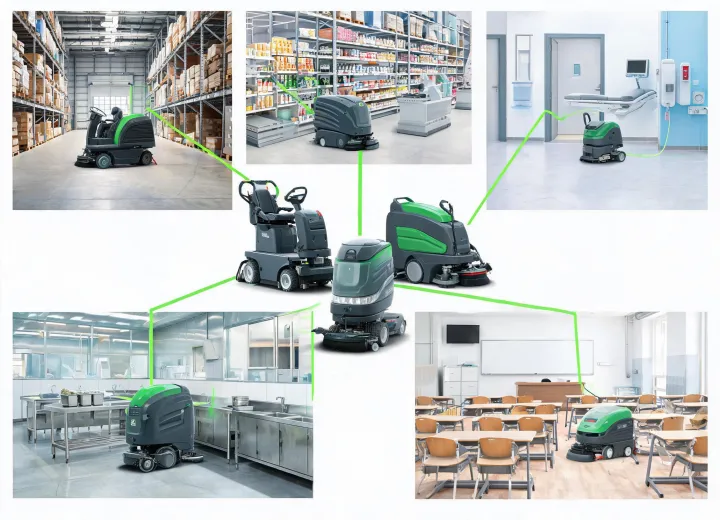
Forklift traffic, dock dust, pallet debris, and long aisles call for durable scrubbers and sweepers with predictable runtime and fast recovery tank routines.
Public floors need low disruption, easy operator handoff, and a clean finish before opening hours or between high-traffic customer waves.
Moisture, residue, and strict hygiene routines require equipment choices that consider washdown patterns, safe recovery, and repeatable cleaning documentation.
Corridors, classrooms, entrances, and patient-facing areas benefit from machines that combine floor appearance, safe dry times, and manageable noise levels.
Production areas may combine dust, oil tracking, packaging debris, and protected walkways. Tennant planning helps separate sweeping, scrubbing, and detail pickup tasks.
Stations, arenas, and civic buildings need robust cleaning windows that account for public events, mixed flooring, and crews that change by shift.
A detailed application review does not need to feel complicated. The strongest starting point is a short list of operational facts your team already knows: when the floor can be cleaned, what kind of soil appears, where operators store the machine, and which maintenance tasks are realistic between shifts.
As a planning reference, walk-behind scrubbers typically clear a 17 to 28 inch scrub path with a 6 to 13 gallon solution tank, while ride-on machines move into the 28 to 45 inch path range with 30 to 60 gallon tanks. Sweeper hoppers commonly span 1 to 9 cubic feet by class. These ranges are starting points only; the right figure depends on aisle width, soil load, and the charge window your shifts allow.
Commercial floor care rarely has one correct answer. The notes below summarize the recurring selection debates we see across warehouse, retail, food, and healthcare sites, with the case for each side rather than a single recommendation.
| Decision | One side | The other side |
|---|---|---|
| Ride-on vs walk-behind scrubber | Ride-on covers large open floors in fewer passes and reduces operator fatigue on long routes. | Walk-behind costs less, turns in tight aisles, and stores in smaller spaces, which suits multi-room and retail floors. |
| Battery vs corded power | Battery machines roam freely with no trailing cord and clear large areas without outlet planning. | Corded units avoid charge windows and battery replacement cost, but they limit reach and add a trip hazard on public floors. |
| Cylindrical brush vs disc/pad deck | Cylindrical decks sweep light debris while scrubbing, useful where pre-sweeping is skipped. | Disc and pad decks apply higher pressure on ground-in soil and finishes but need a separate sweep step first. |
| One large machine vs a mixed fleet | A single machine class simplifies training, parts, and chargers across the building. | A mixed fleet of scrubbers, sweepers, and vacuums matches each zone better but raises stocking and training overhead. |
Industry dispute reference data was not available for this segment, so the comparisons above are framed conservatively as selection trade-offs rather than ranked verdicts. Tennant can review your specific zones before any category is fixed.
Specifications on paper are a starting point, not proof. The repeatable way to confirm a machine is right is a measured demonstration on your own floor: clean a representative aisle with your actual soil, time the pass, check recovery and dry time, and record battery draw against your shift window. A walk-behind and a ride-on can be run side by side on the same lane so the comparison is your floor, not a brochure. Application engineers can structure and document that demo on request.
Recovery squeegees handle a wet film, not flooding or deep spills. Drains, wet vacuums, or pumps belong upstream of a scrubber route.
Nails, gravel, and bulk rubble damage brushes and clog hoppers. Sites in active build-out need manual clearing before machine cleaning starts.
Aisles under roughly 30 inches, crowded fixtures, and frequent thresholds slow ride-on machines; compact walk-behind or manual methods often finish faster.
Share your industry, floor area, traffic pattern, and current cleaning issue. We will help focus the conversation around the machine categories that make sense first.