
From Push Mops to Robots: What 6 Years of Managing Facility Equipment Taught Me About Floor Care
When I took over facility purchasing in 2019, I had a spreadsheet, three buildings, and absolutely no idea what I was doing with cleaning equipment.
My predecessor left a folder labeled "Floor Care" with two things in it: a laminated spec sheet for an old walk-behind scrubber, and a handwritten note that just said "ask Dave." Dave had retired two years earlier.
So I did what any reasonable person would do. I assumed floor cleaning was floor cleaning. Buy a machine, plug it in, push it around, done.
That assumption cost us roughly $7,400 in the first eighteen months. Here's that story—and what I wish someone had told me at the start.
The First Mistake: Treating Batteries Like an Afterthought
We had two older Tennant walk-behind scrubbers in the warehouse and one in the main office lobby. The warehouse units ran fine. The lobby unit kept dying mid-shift.
My fix was to order replacement batteries from the cheapest online listing I could find. I'm not 100% sure what spec those batteries actually were—the listing was vague, and I was in a hurry. What I do know is they lasted about four months instead of the two-plus years the originals had given us.
Turns out tennant floor scrubber batteries aren't universal. They're sized to the machine's amp-hour draw, charge profile, and duty cycle. Cheap substitutes seem fine on paper but run hot and die early. When I finally called our Tennant service rep, he walked me through the correct spec for each model in about ten minutes.
"You wouldn't put regular gas in a diesel truck because it's cheaper. Same logic applies here."
That one conversation probably saved us more than the entire battery budget I'd wasted. The lesson wasn't really about batteries—it was about not assuming that consumables are interchangeable across a fleet.
Learning How the Machines Actually Work
Once the battery situation stabilized, I hit a different problem: our custodial team kept filing complaints about the same machines. "It's not picking up water." "The squeegee streaks." "The pad wears out in a week."
I sat down with one of our lead custodians for an afternoon and asked her to walk me through tennant floor scrubber how to use—the way she actually used it, not the manual version. What I found out was uncomfortable.
Nobody had been properly trained. The machines were being run at full speed on high-traffic rough concrete, which chewed through pads and left water behind. Solution flow was cranked to maximum because "more water means cleaner." Squeegees hadn't been adjusted since installation.
We brought in a trainer for a half-day session. Pad consumption dropped. Water pickup improved. Complaint tickets on floor care dropped from about eleven a month to under three.
I'll be honest—I felt pretty dumb. Two years of blaming machines when the real problem was that we were operating $6,000 equipment like it was a $200 vacuum.
The Turning Point: When Manual Stopped Scaling
By early 2023, we'd added a fourth building—a 90,000 sq ft distribution space with wide aisles. Our team was spending close to fourteen hours a week just sweeping. That's more than a full shift on one task, and it was eating into everything else.
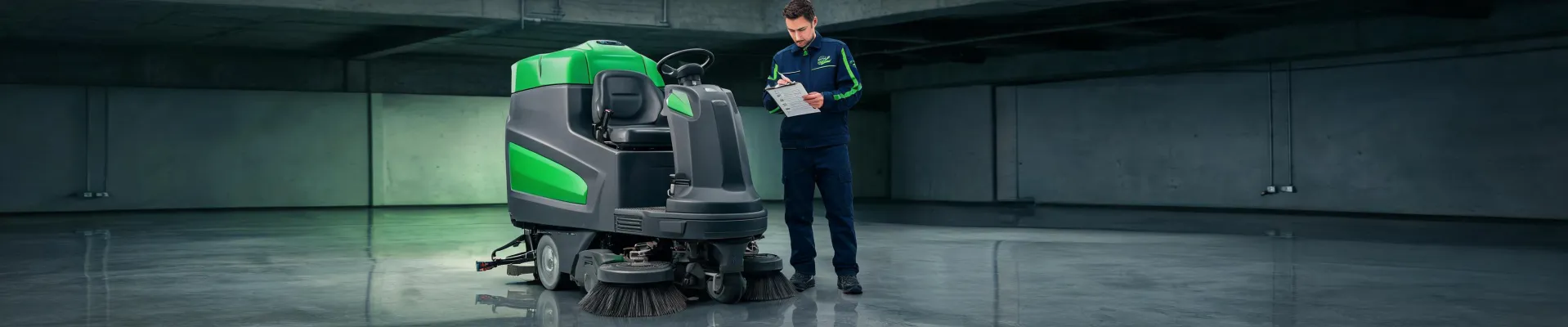
I started looking at a floor sweeper automatic option—the ride-on kind that handles large open areas without a driver pushing it. The quote was steep. I put it in front of our ops director and she asked a question I couldn't answer: "How does this compare to what we're paying in labor?"
I hadn't run that math. When I did, the numbers were uncomfortable in the other direction. At the fully-loaded labor rate we were carrying, the sweeper paid for itself in about twenty-two months, assuming it lasted the six years the manufacturer claimed. It lasted seven.
Post-decision doubt hit hard the week it arrived. What if our team couldn't operate it? What if the maintenance contract was a money pit? What if it broke down mid-quarter and we were back to brooms?
None of that happened. But the worry was real, and I think it's healthy. Anyone who approves a five-figure equipment purchase and doesn't lose sleep the week it arrives is either lying or not paying attention.
The Weird One: Air Quality and a Standing Dust Collector
This wasn't on my 2024 roadmap at all. Our safety manager flagged that fine dust in the distribution center was exceeding accepted thresholds during peak sorting hours. We tried everything obvious—ventilation adjustments, scheduling changes, more frequent sweeping.
What finally moved the needle was a standing dust collector positioned near the highest-activity zone. I'd always associated dust collectors with woodshops and machine rooms, not warehouse aisles. But the principle is the same—pull particulates out of the air before they settle everywhere and get re-suspended.
Air quality readings improved within a month. Fewer respiratory complaints from the night shift. And the floor stayed cleaner longer because dust wasn't constantly raining back down onto freshly swept surfaces.
Sometimes the equipment isn't about cleaning. It's about removing the source of the problem.
Where the Industry Is Actually Going
Late last year I sat through a demo of a commercial robot floor scrubber. Our team was skeptical—I was skeptical. So I asked the obvious question: how does a commercial robot floor scrubber work, really? Not the marketing version, the operational version.
The honest answer: it maps the space with sensors, follows a stored route, and scrubs or sweeps within defined zones. It doesn't replace a person—it replaces the routine pass a person would otherwise do. Someone still handles edges, restrooms, and any spot that requires judgment.
We're piloting one now in the office building where traffic patterns are predictable. Too early to give you real numbers. But I'll say this: what was best practice in 2019—buy a scrubber, assign an operator, hope for the best—doesn't hold up in 2025. The equipment is doing more of the thinking. The human role is shifting toward exception handling, not routine operation.
The fundamentals of floor care haven't changed. Dirt still has to be lifted, water still has to be recovered, air still has to be filtered. But the execution has evolved in ways I genuinely didn't anticipate six years ago.
What I'd Tell My 2019 Self
Three things, in order of how much time they'd have saved me:
- Specify consumables the way you'd specify capital equipment. Cheap batteries, pads, and filters cost more over their lifespan than the right ones do. Full stop.
- Training is not a checkbox. A half-day with a real trainer saved us more than any single equipment upgrade.
- Do the labor math before you do the equipment math. The purchase price is rarely the deciding factor. What the machine replaces on the schedule almost always is.
We're still a mid-sized operation. We still make mistakes. But we're making fewer of the expensive ones now, and that feels like progress.
If you're managing facility equipment and something feels off—streaking floors, dying batteries, dust that won't settle—the answer is usually not "buy a new machine." It's almost always "understand the one you have." Start there.

Elise Marceau
Elise Marceau is an LED display and digital-signage systems analyst covering LED video walls, modular screens, transparent LED, control processors, and indoor or outdoor signage. She applies IEC 62368-1 safety principles while comparing pixel pitch, luminance, contrast, refresh rate, colour uniformity, viewing angle, ingress protection, power density, module serviceability, and signal redundancy. Her specification guides help integrators, venue operators, retailers, and procurement teams align viewing distance, ambient light, content format, installation access, electrical load, and lifecycle support.