
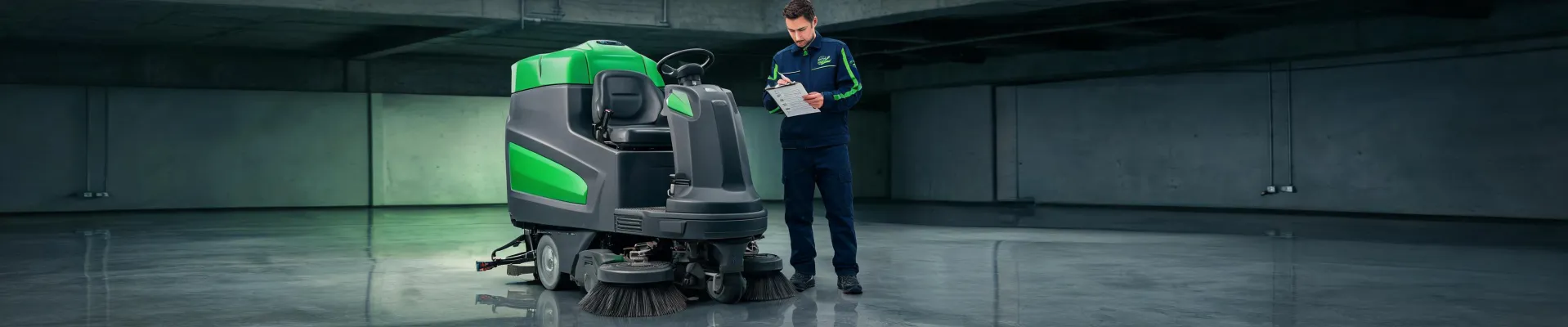
I Wasted $15,000 Buying Floor Scrubbers. Read This Before You Buy a Commercial Floor Cleaning Machine
Buying a commercial floor cleaning machine comes down to one thing most buyers skip: the floor audit. I learned that after losing roughly $15,000 on equipment mistakes before I finally bought the Tennant auto scrubber we use today. If you haven't mapped your floors, your traffic patterns, and your debris load, you aren't ready to buy any floor scrubber—Tennant included. Your facility should dictate the machine, not the other way around.
I say that as someone who's managed industrial cleaning operations for seven years (since 2018). I currently oversee roughly 180,000 square feet across three warehouse and production sites. I've bought machines that were too big, too small, and just plain wrong for the floor. I've made the used-equipment mistake, the battery mistake, and the "one machine fixes everything" mistake. I now keep a pre-purchase checklist on my office wall so our team never repeats any of them.
The Used Tennant 5680 That Taught Me the Real Cost
Here's the biggest one, and the one that hurt the most.
In March 2023, I bought a used Tennant floor scrubber 5680 at what looked like a great price. The spec sheet checked out, the hour meter was reasonable, and the dealer's photos showed a clean unit. But there was one nagging detail: I called their service line twice and got voicemail both times. Nobody returned my call until the day after I'd already wired the deposit.
I ignored my gut. That was the real mistake.
The 5680 cleaned fine for the first few months. Then the batteries started fading. By January 2024, runtime had dropped from three-plus hours to under ninety minutes. We were charging it twice per shift and still leaving stains in the traffic lanes. Replacement battery quote: $3,200 before install. Not long after, the electronics board failed, and replacement parts took nearly three weeks to arrive because the model is aging out of the parts pipeline. We paid a contract cleaning crew $2,100 to cover the gaps while the machine sat in our bay.
Here's the math: $5,200 for the used unit, $3,200 for batteries, $1,850 for the board, $2,100 for stopgap labor. That's $12,350 for a machine we stopped using entirely by October.
The lesson I wrote down was simple: the purchase price is the smallest part of the total cost. Time offline, parts delays, and emergency labor all count—and they count more than most buyers realize.
The Floor Audit That Changed How I Buy
After the 5680 ordeal, I did something I should have done before ever typing "commercial floor cleaning machine for sale" into a search bar. I audited all three sites, and I did it properly—with a checklist and a tape measure.
Here's what I found.
Our main warehouse has 42,000 square feet of sealed concrete. The daily dust load is moderate, and the traffic lanes are predictable. Our production floor has epoxy coatings that pick up fine powder like nothing I've ever seen, and no scrubber alone can handle it—a dust floor sweeper has to run first. And the staging area is a mess of cardboard, plastic strapping, and the occasional oil spot, which means it needs a strong scrub deck and wide pickup, not a delicate machine.
Three sites. Three different floor problems. Looking for one generic machine was never going to work, but that's exactly what I'd been doing.
Most buyers focus on cleaning width, horsepower, and battery voltage and completely miss the debris profile—the thing that decides whether a machine will actually perform on your floor. I was exactly that buyer. The question everyone asks is, "How big is the machine?" The question they should ask is, "What's on my floor, and how does this machine handle it?"
Get a Dust Floor Sweeper Before You Need It
Here's a lesson I learned the hard way in 2022. We tried using a scrubber on floors covered with light packaging dust and wood splinters. The result was a gray, clay-like slurry that dried into a haze over the whole floor. We literally made the concrete worse.
One of the overnight guys started calling it "floor mud," and the phrase stuck. We spent a weekend and about $2,000 on re-etching and deep cleaning to undo what one well-intentioned scrubber pass had done.
That weekend changed my mind about dust floor sweepers. I used to treat them as an optional add-on—a nice-to-have. Now I'd get a sweeper before I'd get a scrubber in any facility with dry debris, powder, or dust. The order matters: sweep first, scrub second. If you reverse the sequence, you'll burn pads, waste time, and create a film that's worse than what you started with. (I also learned that "floor mud" is not a phrase you want the production manager repeating.)
Dealer Support and Rental Testing: Two Due Diligence Steps That Pay Off
A mid-January breakdown at a site I was overseeing in Boise, Idaho, taught me more about buying floor scrubbers than any spec sheet ever did.
Our sweeper died during a busy stretch. I called three equipment dealers looking for a part. Dealers one and two didn't have it in stock and quoted three to five weeks. The third, a Tennant dealer, had a service van at our door within 36 hours with the part already in hand.
That was the single fastest repair turnaround I've seen in seven years of managing industrial cleaning equipment. It's also the reason I stopped treating price as the main variable. If you're looking for a floor scrubber in Boise or anywhere else, ask about parts availability and service response times before you ask about the warranty. A cheap machine that takes two weeks to fix is not cheap.
The other step I refuse to skip now is rental testing. We rented a popular contender for three days and ran it across every floor in all three buildings. We timed the runtime, measured the square footage it actually cleaned per hour, and checked it against every doorway, racking section, and tight turn.
The rental test caught something the spec sheet never mentioned: the machine didn't fit under the racking in our staging area. Clearance was off by about three inches.
So we sent it back, rented a Tennant auto scrubber the following week, and ran the same test. It passed everything, including the racking clearance. A three-day rental cost us $480 each time. It was the cheapest due diligence I've done in this job.
The Pre-Purchase Checklist I Use
Both of those lessons made it into the checklist that's been taped to my office wall since March 2024:
- Map the floors. Concrete, epoxy, tile, coated? Which areas need scrubbing, which need sweeping, which need both?
- Measure the debris load. Fine dust, packaging, wood, metal shavings? If there's dry debris, a dust floor sweeper is part of the system.
- Check the charging reality. Can the batteries fully recharge between shifts? What's the electrical load on the building?
- Measure your clearances. Doorways, dock plates, racking, elevators. Get the tape measure out.
- Interview the service desk. Call on a Friday afternoon. Ask how they handle parts that aren't in stock.
- Rent before you buy. A few hundred dollars now can prevent a five-figure mistake later.
When It Makes Sense to Break These Rules
I don't want to pretend the list above is holy scripture. There are situations where I'd loosen the rules.
A used machine can be a smart buy if the dealer provides a full inspection, new or nearly new batteries, and a parts warranty. The problem with our 5680 wasn't that it was used. It was that the batteries were degraded, the dealer had no service presence, and the parts pipeline was already drying up. Three red flags I noticed before buying. I just chose to ignore them.
And if your space is under 20,000 square feet with light soiling, a ride-on scrubber is probably overkill. A walk-behind machine or a well-managed manual cleaning program might serve you just as well. Buy for the floor you actually have, not the floor you're hoping to own someday.
Finally, if you're dealing with a seasonal surge or a pilot project, renting beats buying every time. We rent extra sweepers in the fourth quarter when our inventory swells. The rental line item is cheaper than owning a machine that sits idle for nine months.
Bottom line: shop with your facility map, your debris profile, and your dealer's response time in front of you. Everything else is just specs on a page. I'd rather spend ten minutes explaining this to a buyer than watch them learn it with a five-figure paperweight like I did.

Elise Marceau
Elise Marceau is an LED display and digital-signage systems analyst covering LED video walls, modular screens, transparent LED, control processors, and indoor or outdoor signage. She applies IEC 62368-1 safety principles while comparing pixel pitch, luminance, contrast, refresh rate, colour uniformity, viewing angle, ingress protection, power density, module serviceability, and signal redundancy. Her specification guides help integrators, venue operators, retailers, and procurement teams align viewing distance, ambient light, content format, installation access, electrical load, and lifecycle support.