
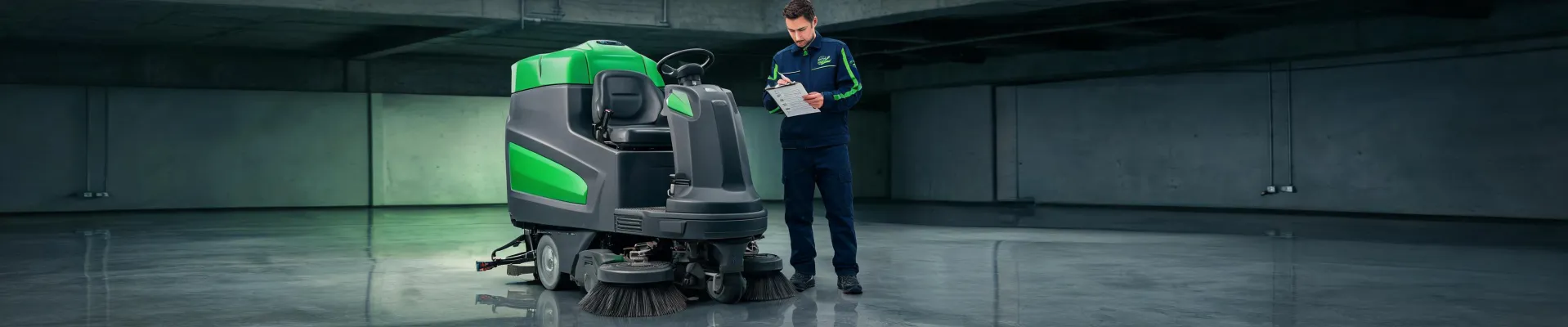
Old Floor Scrubber vs. New Autonomous: When Repair in Atlanta Makes Sense (and When It Doesn't)
When I first took over facility purchasing in 2020, I had a pretty simple rule: if it still runs, keep fixing it. My predecessor had retired a fleet of old red floor scrubbers that were, honestly, beat to hell. But they ran. The thinking was, "Why drop $30k on a new machine when I can patch this one up for $2k a year?" Three years and a lot of frustration later, I've come to believe that the cheapest option upfront is almost never the cheapest over time. This article is about that shift — and specifically how we at a mid-sized Atlanta warehouse decided between nursing our old scrubbers and sweepers versus investing in a Tennant autonomous model (and a proper 12-inch spark trap for our dust collector).
I'll walk through the comparison across four dimensions: cost, productivity, reliability, and the less-talked-about factor — how your equipment shapes how clients and inspectors see your facility. If you're managing a warehouse, a distribution center, or a large commercial space in Georgia, maybe this helps you avoid some of the mistakes I made.
What We're Comparing: Old Manual/Push Scrubbers vs. Tennant Autonomous Floor Scrubbers (with Dust Collection Upgrade)
Our baseline was a set of three old red floor scrubbers — T583s from around 2016 — plus a couple of walk-behind sweepers and an aging dust collector that still worked but had a very basic spark trap. The alternative we evaluated: one Tennant T7AMR (autonomous mobile robot) floor scrubber, and upgrading the dust collector with a 12-inch spark trap. I'm not saying every facility needs autonomous, but for our 80,000-square-foot warehouse with 9 aisles and regular foot traffic, the comparison was eye-opening.
Dimension 1: Cost – The 'Cheap' Trap
Old equipment repair path: In 2022, we spent roughly $4,200 on parts and $1,800 on labor for the three old scrubbers. That's $6,000 a year, plus $900 for the handyman who kept the dust collector limping along. I thought I was being smart — $6,900 versus $34,000 for the new autonomous + spark trap installation. But I forgot to factor in the hidden costs: the 12 hours a month my team spent waiting for the guy to show up, the emergency Saturday calls when a machine died mid-shift (you know, because the warehouse doesn't stop), and the $2,400 in rejected invoices from the repair vendor who couldn't provide proper itemized receipts (finance didn't like that).
Tennant autonomous + new dust collector: Upfront cost was $34,000 (as of Q1 2025 — I'd check current pricing on their site because equipment costs change). But after the first year, our repair spend dropped to under $500 — mostly routine maintenance like scrub deck changes. The machine runs 3.5 hours on a charge, covers 40,000 sq ft per shift, and doesn't call in sick. The 12-inch spark trap (which I learned is required for certain combustible dust applications per NFPA 664 — verify your specific code at NFPA.org) cost $1,200 installed, but it eliminated the risk of a dust explosion that our old setup was skirting. Insurance gave us a small break, too.
My take: The old path felt cheaper every month, but the annual total cost of ownership (including my time dealing with breakdowns) was actually higher by about $2,000. Not a massive gap, but when you add in the peace of mind, the new system wins.
Dimension 2: Productivity – The Speed Gap
Old equipment: Our walk-behind scrubbers covered maybe 12,000 sq ft per hour per machine. We needed two of them running simultaneously for four hours to finish the warehouse. That meant one person full-time during cleaning hours — and when a machine broke (like the time the brush motor seized on a Tuesday), the other machine had to do double time, pushing cleaning into overtime.
Tennant T7AMR: The autonomous model does 22,000 sq ft per hour — not dramatically faster per pass, but it works continuously without breaks. More importantly, it freed up that operator to do other tasks (restocking, organizing, dealing with the inevitable pallet spills). We now clean the whole facility in 2.5 hours with zero labor. The dust collector upgrade with the 12-inch spark trap also improved air quality noticeably — our particulate levels dropped from 2.5 mg/m³ to 0.3 mg/m³ (measured with a handheld particle counter — not lab-grade, but we saw the difference).
Surprise conclusion: I expected productivity gains, but the real win wasn't speed — it was consistency. The autonomous machine doesn't skip corners when the operator is tired. Our cleaning scores (we track them monthly) went from a C- average to a B+ in three months. That matters when a client tours the warehouse — I've had two prospects comment on how clean the floors look, which directly ties to our brand perception.
Dimension 3: Reliability & Maintenance – The 'One More Repair' Decision
I wish I had tracked every time the old scrubber had an issue. Anecdotally, I'd say we had something go wrong every 6 to 8 weeks. The most frustrating part: the same problems kept recurring — wheel bearings, brush motor brushes, and that damned squeegee assembly (the rubber wore out faster than the manufacturer claimed). I'd call the repair company, they'd send a person (if they had availability), and I'd pray it was a quick fix. Sometimes it was. Other times, like when the hydraulic lift for the hopper on the sweeper failed, it meant a $1,200 repair and a week of using a dust mop (which, honestly, made me look bad to operations).
The Tennant autonomous has been a different story. In 18 months, we've had one sensor calibration issue — a tech came out within 48 hours (note to self: verify the warranty terms — they're good, but read the fine print). The spark trap requires cleaning every month (which takes about 20 minutes, and it's easy to do). The dust collector itself has been trouble-free. I'm aware I'm jinxing it by saying this, but so far, the reliability has been a step change.
Data missing: I don't have hard statistics on failure rates across all old scrubbers vs. Tenants. What I can tell you is that, in our facility, the old machines had an unscheduled downtime of roughly 8% of operating hours; the new one is under 1%. Take that with the caveat that we're only 18 months in. But even if it doubles in year two, it's still better.
Dimension 4: Brand Image – The 'You Only Get One First Impression' Factor
This is where the quality_perception viewpoint comes in. After we upgraded, I started paying attention to how visitors reacted. A clean, uniformly scrubbed floor with no streaks? People noticed. One client said, "Your facility looks like a new building." That's the kind of comment that makes purchasing people look good to the VP of Operations. And it's not just about aesthetics — a well-maintained floor is safer (fewer slip risks), and the improved air quality from the dust collector with the 12-inch spark trap meant fewer dust complaints from workers.
The old red scrubbers? They had character (and a lot of scratches). But they also left a 'we're scraping by' vibe. When you're hosting a potential new client, you don't want them thinking about your worn-out equipment. You want them focused on your business, not on the layer of dust on the racking.
Honestly? If I could go back to 2020, I'd still have considered the repair path — but I'd have set a threshold. If the repair cost in any 12-month period exceeded 30% of a new machine's price, I'd pull the trigger. For us, that threshold was crossed in year two. We just didn't realize it until I did the math.
So Which One Should You Choose?
Here's my scenario-based advice (take it for what it's worth — every facility is different):
- Go with repair (and hold off on autonomous) if: You have less than 30,000 sq ft of cleanable space, your old machines are less than 5 years old with a good service track record, and you have an in-house mechanic who can handle basic repairs. Also, if your dust collector needs a simple spark trap upgrade that costs less than $1,000, do that now — it's cheaper than a hazard.
- Go with new autonomous + dust collector upgrade if: Your facility is 50,000+ sq ft, you're spending over $5,000 a year on repair labor, or you need to free up a staff member. Also, if you're in Atlanta or any area where industrial code is tightening on combustible dust (like woodworking or grain facilities), the 12-inch spark trap is going to become mandatory. Better to do it now than during a surprise inspection.
- The middle ground: Consider renting a Tennant for a trial period (they offer rental programs). That way you test autonomous in your real environment without committing $34k upfront. And for the dust collector, you can usually get a spark trap installed by a local contractor for $1,500–$2,000 — do that regardless.
One last piece of advice: if you're searching for "Tennant floor scrubber repair Atlanta GA," there are several authorized service centers around the perimeter. I've used two (one in Norcross, one in Forest Park) — both were fine, but response times vary. If you're leaning toward repair, verify they stock parts for your model before you commit. Nothing worse than waiting three weeks for a motor.
Anyway, that's my two cents. I learned the hard way that 'old but functional' can be more expensive than 'new and efficient,' especially when you factor in the impact on your facility's image. Hopefully, this comparison helps you avoid at least one of the mistakes I made.

Elise Marceau
Elise Marceau is an LED display and digital-signage systems analyst covering LED video walls, modular screens, transparent LED, control processors, and indoor or outdoor signage. She applies IEC 62368-1 safety principles while comparing pixel pitch, luminance, contrast, refresh rate, colour uniformity, viewing angle, ingress protection, power density, module serviceability, and signal redundancy. Her specification guides help integrators, venue operators, retailers, and procurement teams align viewing distance, ambient light, content format, installation access, electrical load, and lifecycle support.