
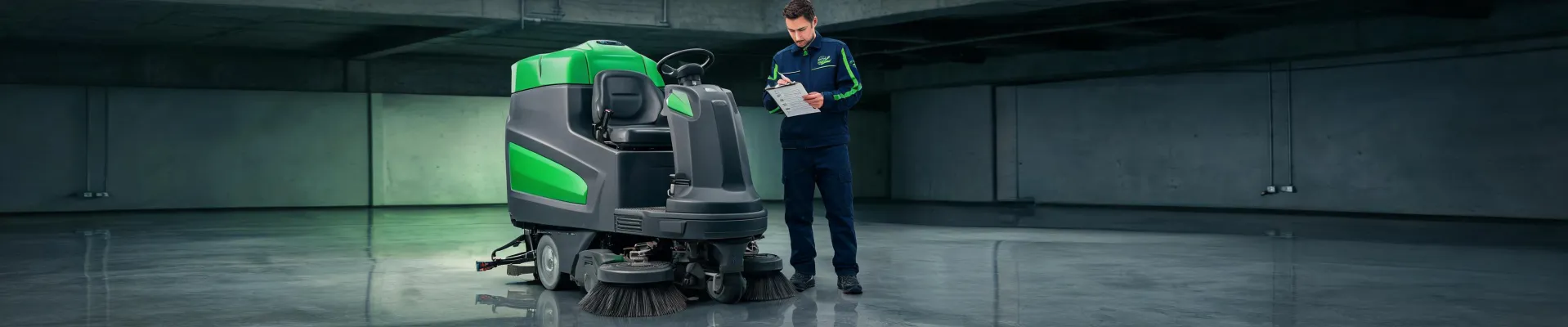
Tennant Floor Scrubber Down 72 Hours Before an Audit—What We Did About It
March 2024, 2:47 PM. The kind of call you learn to recognize before you pick up the phone.
A facilities director I'd been working with for about a year, let's call him Dan, was standing in a 25,000-square-foot production hall watching his floor scrubber refuse to move. The motor had locked up. The machine was an older, no-name scrubber his predecessor had bought used, and the local repair shop said the part was ten days out, minimum. Dan's bigger problem: a major customer audit was walking through that facility in 72 hours.
He wanted to know if we had a rental. Over the next three days, we both learned a lot about what "urgent" actually means.
The First Hour: Triage Before Price
The first thing I did—and it sounds routine, but it's the difference between a good call and a bad one—was ask questions. Not about price. About the building.
- How many square feet per zone? A Class 1000 cleanroom at 1,500, production at 25,000, office at 8,000.
- What floor finish? Sealed polished concrete in production, epoxy in the cleanroom, LVT in offices.
- Who's operating the machine? Two janitorial staff, normal shifts.
- And the one everyone forgets: what kind of debris ends up on the floor each day?
That last question mattered. Dan's production floor collects packaging dust, cardboard shreds, and fine particulates. A scrubber without proper pickup will turn that into a streaky mess. If debris had been the main challenge, the Timberline floor scrubber—which sweeps and scrubs in a single pass—would've been the obvious play. But the real issue was time, not debris type.
Time pressure does something funny to decision-making. When everything feels like an emergency, we reach for the cheapest fix that fits the deadline. I've done it too. Back in 2023, I pushed a client toward a budget rental because their numbers demanded it. The machine, a different brand, couldn't handle their floor finish. The rental cost 40% less than our recommended option; they spent three times that in extra labor and eight hours of rework before their event. I still kick myself for agreeing to that.
That's the same mistake Dan was about to make. And honestly, his spreadsheet made it look completely reasonable.
When the Spreadsheet Was Wrong
Dan had done the math. A walk-behind scrubber rental for three days: roughly $450. A ride-on scrubber rental: about $1,100 plus delivery. The walk-behind was the obvious choice, on paper.
On paper.
The flaw wasn't the math. It was the invisible line items. A walk-behind on a 25,000-square-foot production floor means hours of walking. I'm talking two shifts, combined six hours a day, plus the tired-person mistakes that come with long machine time. The ride-on does the same floor in 45 minutes with a far more consistent finish.
And then there was the cleanroom. You can't take a standard walk-behind into a Class 1000 cleanroom. A cleanroom floor scrubber needs HEPA-filtered exhaust so it isn't pumping particulates into the air while it cleans. That's a spec, not an upgrade, and none of the budget rental sites show you that in their price comparison.
The numbers said walk-behind. My gut said ride-on for production, cleanroom-spec for the ISO zone, and a walk-behind for the office. We went with the gut. The lesson I keep telling clients: an emergency spreadsheet is only as good as the variables you put in it, and the variables you can't quantify—consistency, compliance, the impression a floor makes on an auditor—are usually the ones that matter most.
Three Zones, Three Machines
Production floor: a rented T17 ride-on scrubber
We had a T17 coming back from a fleet rotation at another site. I flagged it immediately. That machine got a deep clean, a full charge, and a ride to Dan's dock at 4 AM the next morning, plus a $250 rush delivery fee (note to self: add buffer to every fleet rotation from now on). The T17 ran the production floor in under an hour and laid down a uniform finish. Dan stood there watching it make a full pass and said, "This is why you kept bringing up the T17."
Office and common areas: a Tennant T5 walk-behind scrubber
The T5 is one of my favorite machines for tight spaces. It's easy to handle, reliable, and an experienced operator can get a genuinely professional finish in corridors and break rooms. For an 8,000-square-foot office zone, it's the right answer 90% of the time. If you're searching "tennant t5 floor scrubber" because you're in a similar spot—walk-behind, office, small warehouse—this is the class of machine to look at first.
Cleanroom: a cleanroom-spec machine with HEPA exhaust
This was the one piece of equipment Dan couldn't compromise on. We brought in one of our cleanroom-certified machines—same family as the T7 line but configured with the filtration that Class 1000 spaces require. It costs more to rent, and it doesn't show up on comparison charts as anything other than "expensive." But if you're audited in pharmaceutical or medical device manufacturing, it's a requirement. Skipping it isn't saving money; it's gambling with the whole audit outcome.
Dan didn't blink at that line item. That's when I knew he understood what I'd been saying: quality perception lives in the details people don't notice until they're specifically looking for them.
One side note: one of Dan's staff suggested they just mop the cleanroom. I get the temptation—it seems simpler. But mop-and-bucket doesn't meet the particulate spec for a Class 1000 space. It's not that mopping is a bad method; it's that it's the wrong tool for this requirement. That distinction matters.
The Real T17 Price Conversation
The audit passed—I'm jumping ahead, but it's relevant. Afterward, Dan asked the question he'd been holding back all week: "What does a T17 actually cost to buy?"
"Tennant t17 price" is a search I see a lot, so let me be straightforward. Based on dealer quotes I've seen over the past year, a new T17 ride-on scrubber typically lands in the $45,000–$60,000 range depending on options, battery type, and your relationship with the dealer. That excludes freight, setup, and training. As of early 2025, that's the market as I understand it. It's a starting point, not a guarantee—verify with current quotes before building your budget.
Dan did the sharp-intake-of-breath thing. Normal. The counterintuitive part is what I walked him through after:
A walk-behind on that production floor takes two people about three hours per shift. A T17 takes one person 45 minutes. That labor difference, across two shifts and five days a week, works out to roughly $25,000–$35,000 per year depending on your rates. So a $50,000 machine pays for itself in about 18 months. After that, it's saving money while making the floor look better, every single day.
That's why I never argue against a good ride-on on price alone. The price is only meaningful compared to the alternative—and the alternative isn't just another machine. It's the labor, the overtime, the inconsistency, and the occasional catastrophic failure that costs you an audit.
The Auditor Walked the Floor
Friday afternoon, Dan texted me a photo of the production floor at 1 PM, still damp in spots, the T17 parked at the far end in its designated spot. The auditor's first comment after the opening meeting, according to Dan: "Your facility looks fantastic. You clearly keep things in order."
No cleaning protocol questions. No inspection flags. The floor spoke before anyone could.
I've done this long enough to stop being surprised by how often a floor crisis is really a reputation crisis in disguise.
What About an Office Robot Scrubber?
Dan also asked about his office zone. We had a demo unit of the T7AMR, Tennant's autonomous robot scrubber, and I brought it over on a Tuesday afternoon. If you've never watched one work: it maps the space, drives itself around chairs and glass partitions, returns to its dock, empties, and recharges—all without a person standing there. For a facility manager with an office area that doesn't justify a dedicated operator, an office robot floor scrubber is a legitimate option.
The math is different from a ride-on. The robot costs more per square foot cleaned than a walk-behind, but it comes out ahead if you're paying anyone to scrub that office at night. Dan's 8,000-square-foot office sits right around the break-even point. We didn't sell him one that day. Two months later, he called back asking to borrow the demo for his budget committee. It's on their capital plan this year.
If Your Scrubber Just Died: What Actually Helped
If you're reading this because your machine gave up mid-shift, here's the condensed version of Dan's emergency:
- Put a machine on the floor before you panic about the price. A rush rental costs more—expect a 25% to 50% premium over standard rates—but it's a fraction of the cost of overworking your staff or failing the audit itself. In Dan's case, the $250 rush fee was the cheapest part of the whole operation.
- Match the machine to the zone. A T5 for tight spaces. A T17 for production-scale footage. A cleanroom floor scrubber with HEPA for any ISO-classified room. Whether you rent or buy, the spec doesn't change.
- Ask what your spreadsheet is missing. Labor hours, compliance risk, the cost of a first impression. That's where the real price lives.
Bottom Line
The audit passed. Dan bought a certified used T17 from us a few weeks later. The office robot is on the capital plan. And the lesson that stuck with him—and with me—is that the quality of your floor is inseparable from the quality of your brand.
If you're staring at a dead scrubber right now, the first call you make is less important than the questions you ask before you spend money. Match the machine to the job. Take the rush premium seriously. And don't let a spreadsheet make a decision your gut has already flagged for review.

Elise Marceau
Elise Marceau is an LED display and digital-signage systems analyst covering LED video walls, modular screens, transparent LED, control processors, and indoor or outdoor signage. She applies IEC 62368-1 safety principles while comparing pixel pitch, luminance, contrast, refresh rate, colour uniformity, viewing angle, ingress protection, power density, module serviceability, and signal redundancy. Her specification guides help integrators, venue operators, retailers, and procurement teams align viewing distance, ambient light, content format, installation access, electrical load, and lifecycle support.