
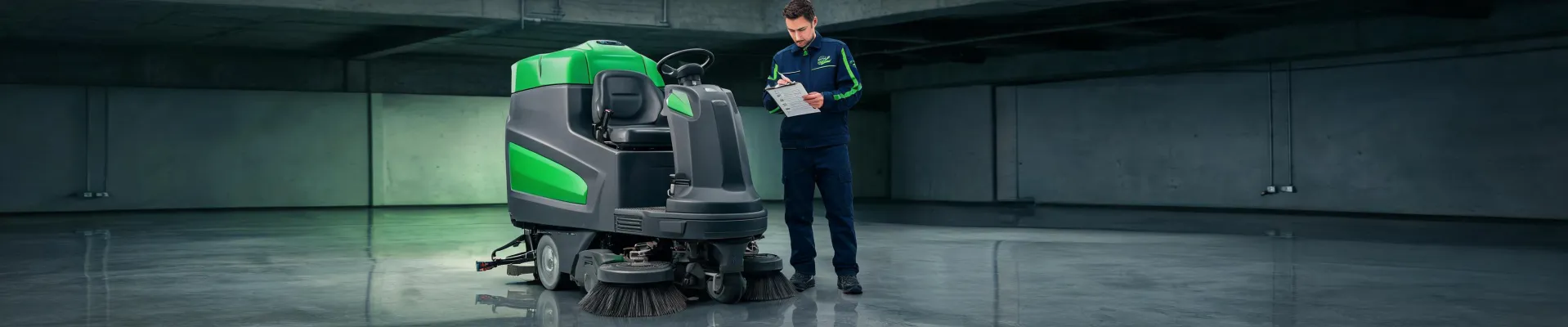
Tennant Machine Down? A Facilities Emergency Coordinator's Guide to Repair vs. Replace
Start with a $15 Phone Call, Not a $6,500 Purchase Order
If your floor scrubber stopped working today, the odds are roughly 3-to-2 that it needs a repair, not a replacement. I've been coordinating emergency equipment service since 2019. Last year alone, my team handled 47 rush calls across the Southeast, and about 60% of those ended with a repair bill under 10% of what a new machine would have cost.
The facilities that call me at 5 AM are usually in one of three situations: the machine threw an error code and won't start, the machine starts but won't clean effectively, or the machine works but is making a noise that signals imminent failure. Two of those three are usually fixable the same day.
Here's the first question I ask every time: "Does it move?" Not "Can you scrub?" Not "What's the error code?" Does it move.
If yes, the drive system, motor, and battery are probably fine. You're looking at a sensor, a brush deck issue, a squeegee problem, or a vacuum hose clog. Those run $50–$400 in most cases. If no, the diagnosis gets more serious and replacement becomes more likely.
Why the Diagnostic Always Beats the Quote
In March 2024, a grocery chain manager called me at 5:12 AM. His Tennant T300 — a walk-behind floor scrubber machine — had stopped mid-shift. The store opened at 7 AM. Health code required clean floors.
His first instinct was to call a rental company. His second instinct, after I asked the "does it move" question, was to call a service tech. It moved fine — the brush deck was jammed. Ninety minutes and $230 later, he was cleaning. A rental would've cost $180 per day with a week minimum. A replacement T300 runs $5,500–$7,500 depending on configuration.
That said, this approach isn't universal. A facility running twelve scrubbers on a tight maintenance schedule has different needs than a small warehouse with one machine. The calculus changes when downtime affects multiple buildings or shifts.
The Memphis Repair Situation (And Why It's Better Than You'd Think)
If you're searching for Tennant machine repair in Memphis, TN, you're in a better position than most markets — but not for the reason people assume. It's not the number of service centers. It's the parts distribution network.
Memphis sits at the center of a major logistics corridor. Non-stock parts for most Tennant models arrive in 24–48 hours through regional distribution. In other markets I've worked, that same part takes 5–7 business days. I handled a warehouse emergency last November where a scrubber went down on Monday and was running again by Wednesday afternoon. The part came from a regional point, not the factory.
The catch: you need a service tech who knows how to source from that network. Not every independent tech has those relationships. Ask specifically how they handle non-stock parts before you authorize a repair.
Repair vs. Replace: My 40% Rule
When I'm helping a facility make the repair-or-replace call, I use a simple threshold. If the repair quote comes in above 40% of replacement cost and the machine is more than 5 years old, start pricing new units. Below that threshold, repair is almost always the smarter financial move.
Above that threshold, this is where I tell people to look at energy-saving floor scrubber models. The tech changed in 2024. Current energy-saving units use 30–40% less water and power per square foot than 2019 models, based on spec sheets I've compared across major manufacturers. For a facility running three shifts, the utility savings and extended battery life add up to $1,200–$2,800 per year depending on square footage.
From the outside, a new energy-saving scrubber looks like a sustainability purchase. The reality is that it's a cost-cutting purchase if you're running enough hours. The sustainability angle is real too, but I've seen more facilities switch for the utility bill than for the logo on the side of the machine.
Where Avidbots Floor Scrubbers Fit
I get asked about Avidbots floor scrubbers more than any other autonomous option. Here's my honest take, with a caveat: this is the one area where my experience is thinner. I've overseen two autonomous deployments and consulted on three others.
Avidbots makes the Neo, an autonomous floor scrubber. The value proposition is straightforward: you set it up, it cleans, you don't pay labor to walk behind it. For large facilities with open layouts and predictable floor plans, the ROI can work.
But I've seen it fail twice, and both times were layout problems. One facility had narrow aisles with pallets protruding into the path. The other needed edge cleaning along walls and under shelving, which the autonomous unit couldn't handle. If your facility is tight and cluttered, a walk-behind floor scrubber machine will outperform an autonomous unit every time.
The honest boundary: I can speak to those five deployments and what I observed. If you're dealing with a very different facility type — an airport, a hospital, a massive distribution center — there are probably factors I'm not aware of.
A Note on Tennant Backpack Vacuum Pricing
Different product line, same principle. As of early 2025, Tennant backpack vacuum pricing runs approximately $350 to $600 depending on the model and kit configuration. I've watched facilities overpay by 20–30% by buying from the same vendor that services their scrubbers, just for the convenience of one invoice. That convenience has value. Just know what you're paying for it.
What This Doesn't Cover
I can only speak to mid-size commercial facilities — warehouses, grocery chains, light manufacturing, some hospitality. If you're running a single small office building or a facility with different cleaning needs, the calculus might be completely different. You might not have the volume to justify any maintenance program, in which case leasing or a service contract through the manufacturer may be the smarter path.
Also, this advice assumes you're dealing with a mechanical failure. If the machine is under warranty, the entire conversation changes and you should call Tennant directly before doing anything else. I've seen facilities void warranty coverage by authorizing third-party repairs they didn't need to pay for in the first place.
The one thing that holds true across every situation I've handled: get a diagnostic before you get a replacement quote. That 15-minute call has saved my clients more money than any negotiation I've ever done.

Elise Marceau
Elise Marceau is an LED display and digital-signage systems analyst covering LED video walls, modular screens, transparent LED, control processors, and indoor or outdoor signage. She applies IEC 62368-1 safety principles while comparing pixel pitch, luminance, contrast, refresh rate, colour uniformity, viewing angle, ingress protection, power density, module serviceability, and signal redundancy. Her specification guides help integrators, venue operators, retailers, and procurement teams align viewing distance, ambient light, content format, installation access, electrical load, and lifecycle support.