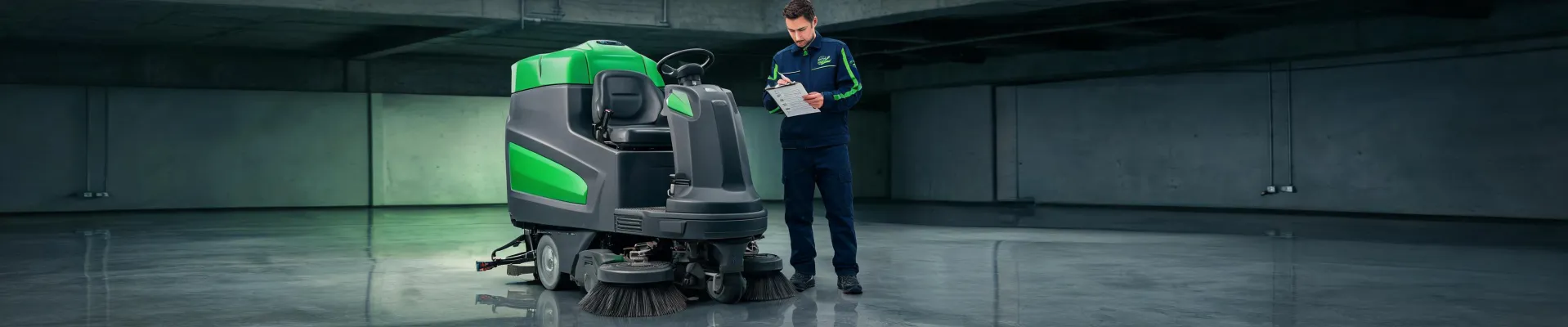
The Real Cost of a Tennant T12: A Buyer's 5-Step Checklist
-
If You're Evaluating Tennant Equipment Right Now...
-
Step 1: Don't Buy the Tennant T12 Yet—Rent One First
-
Step 2: Check the Tennant Carpet Machine Compatibility
-
Step 3: Don't Be Blinded by the Diamond Floor Scrubber Buzz
-
Step 4: Take the DryFT Floor Scrubber Claims with a Grain of Salt
-
Step 5: Look at the Industrial Vacuum Cleaner Market Trends—Don't Ignore Them
-
Common Mistakes to Avoid
If You're Evaluating Tennant Equipment Right Now...
Let me guess—you've been asked to look into floor scrubbers, maybe a Tennant T12 or one of the newer models like the DryFT. You've got a few quotes sitting on your desk, and you're trying to figure out which one actually makes sense for your operation.
I manage purchasing for a mid-sized industrial facility—about 400 employees across 3 locations. I've been through this process a handful of times. Not an expert, but I've made enough mistakes that I've got a pretty good sense of what matters and what doesn't.
Here's the thing: the price tag on a Tennant T12 or a Diamond floor scrubber isn't the whole story. Actually, it's barely half the story. This checklist is what I use now when I'm evaluating new cleaning equipment. It's not fancy, but it works.
5 steps. Do these in order, and you'll save yourself the headache I had two years ago.
Step 1: Don't Buy the Tennant T12 Yet—Rent One First
I know, I know—you want to see the Tennant T12 price and make a decision. But trust me on this one: rent the machine for a week before you commit.
Here's why. The T12 is a popular model, and the specs look great on paper. But specs don't tell you how it handles in your specific environment. A demo in the showroom isn't the same as running it through your warehouse after a busy shift.
When I was evaluating, I rented a T12 for 5 days. Cost me about $350. That rental fee saved me from a $12,000 mistake—turns out the machine's turning radius wasn't tight enough for our narrowest aisles. We went with a different model instead.
If I remember correctly, a new Tennant T12 runs somewhere in the $8,000–$12,000 range depending on options. But don't quote me on that—prices change. What I can tell you is that the rental cost is peanuts compared to the buy and regret cost.
Step 2: Check the Tennant Carpet Machine Compatibility
This is one a lot of people overlook. You might think you're just buying a hard floor scrubber, but what about the Tennant carpet machine setup? If you have any carpeted areas—and most facilities do—you need to know whether the machine you're looking at can handle both.
Some models are dedicated hard floor machines. Others can be switched over with a different brush or pad. The T12, for example, is primarily a hard floor scrubber. If you need carpet cleaning too, you might be looking at an additional machine or an attachment.
Ask the vendor directly: Does this machine clean carpet, or do I need to budget for a separate unit? They'll usually tell you—but you have to ask. The assumption that "one machine does both" is where people get into trouble.
Step 3: Don't Be Blinded by the Diamond Floor Scrubber Buzz
The Diamond floor scrubber technology from Tennant gets a lot of hype. And honestly, some of it is justified—diamond-based scrubbing can give you a noticeably better finish, especially on polished concrete.
But here's the reality check: it's not the right choice for every facility. From the outside, it looks like a no-brainer upgrade. The reality is, diamond technology requires specific maintenance and sometimes different pads or chemicals. If your team isn't trained on it, you might end up with worse results than a standard scrubber.
People assume the Diamond scrubber is always better. What they don't see is the learning curve and the consumables cost.
I've only worked with the diamond system on about 60% of our flooring. For the rest (older tile, some uneven surfaces), the standard brush system actually performed better. Your experience might differ, but it's worth testing before you commit to the technology.
Step 4: Take the DryFT Floor Scrubber Claims with a Grain of Salt
Tennant's DryFT floor scrubber is their newer offering—it's designed to dry the floor as it scrubs, leaving it walkable almost immediately. Sounds great, right? It is, in the right application.
But here's what I've learned: the DryFT works best in low-traffic, controlled environments. In a busy warehouse where forklifts are constantly moving, the drying cycle can get interrupted. The machine has to stop drying if it's moving too fast or if the floor is uneven.
Even after choosing the DryFT for one of our locations, I kept second-guessing. What if we'd have been better off with a traditional scrubber and a separate drying step? The first 3 months until we got the hang of the operating parameters were stressful.
My advice: If your facility has high traffic or uneven floors, a traditional scrubber might actually be more reliable. Don't let the "dry floor" promise override your practical judgment.
Step 5: Look at the Industrial Vacuum Cleaner Market Trends—Don't Ignore Them
I know this sounds like a tangent, but stick with me. The industrial vacuum cleaner market trends for 2024-2025 show a few important shifts:
- There's a move toward battery-powered equipment (lower emissions, quieter operation)
- Internet-connected machines are becoming more common (remote diagnostics, usage tracking)
- Modular designs are gaining popularity (easier to repair, less downtime)
All of these trends apply to floor scrubbers too. Tennant is part of this shift—the DryFT and newer models reflect it. But here's the thing: buying a machine that's too advanced for your team's current capabilities can backfire.
Honestly, I'm not sure why some of these advanced features matter for basic cleaning operations. My best guess is they're designed for large-scale facilities with dedicated maintenance staff. For a mid-size operation like ours, the simpler models with fewer bells and whistles actually performed better.
At least, that's been my experience. If you're running a massive distribution center with a full-time maintenance team, the advanced features might be worth it.
Common Mistakes to Avoid
Before I wrap up, a few things I wish someone had told me:
- Don't buy the cheapest model. The $500 savings on a budget model can turn into $2,000 in repairs within a year. Trust me on this one.
- Do factor in training time. A complex machine is only as good as the operator. If your team can't use it properly, it's a wasted investment.
- Don't forget the consumables. Pads, brushes, chemicals—these add up. A machine that requires proprietary consumables can cost you more in the long run.
- Do check the warranty and service terms. Some vendors offer extended warranties at a reasonable cost. Others charge a premium. Compare apples to apples.
My experience is based on about 6 equipment evaluations over the last 4 years, ranging from $8,000 to $25,000 machines. If you're managing a different scale of operation—say, a single retail store or a massive airport terminal—your experience might differ. But the principles hold up: rent first, ask about hidden costs, and don't let marketing hype override practicality.
Bottom line: The Tennant T12 is a solid machine. The DryFT and Diamond scrubbers have their place. But the right choice depends on your specific facility, your team's capabilities, and your actual cleaning needs. Use this checklist, and you'll make a better decision than going in cold.

Elise Marceau
Elise Marceau is an LED display and digital-signage systems analyst covering LED video walls, modular screens, transparent LED, control processors, and indoor or outdoor signage. She applies IEC 62368-1 safety principles while comparing pixel pitch, luminance, contrast, refresh rate, colour uniformity, viewing angle, ingress protection, power density, module serviceability, and signal redundancy. Her specification guides help integrators, venue operators, retailers, and procurement teams align viewing distance, ambient light, content format, installation access, electrical load, and lifecycle support.