
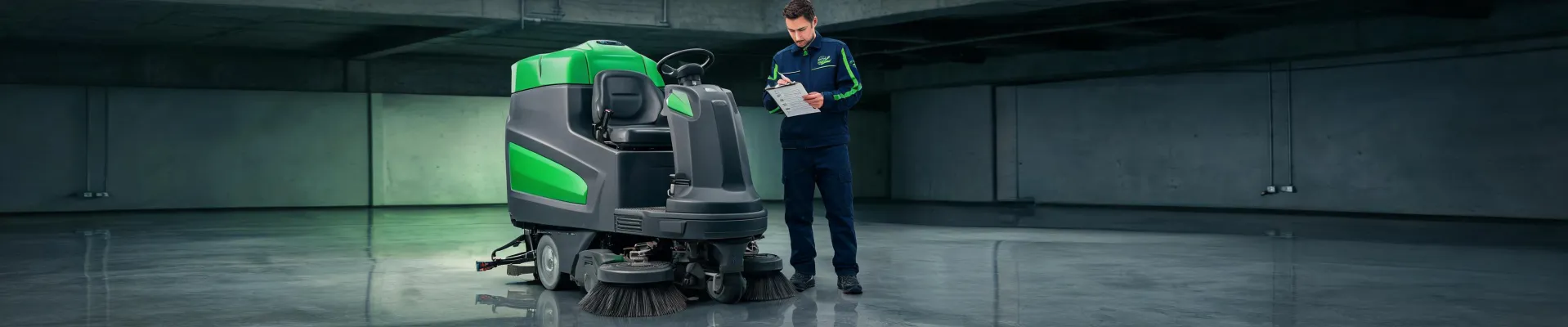
The Used Floor Scrubber That Almost Cost Us $8,400—A Buyer's Reality Check
When the 2025 budget came out, our department got the familiar directive: cut costs, don't sacrifice operations. I manage purchasing for a 400-person facility—floor scrubbers, dust collectors, parts, maintenance contracts. Roughly $200,000 annually across 8 vendors. I report to both operations and finance, which means I feel the squeeze from both directions.
The aging rider scrubber and the dust collection system in our aluminum grinding area both needed attention. And the cheapest path looked obvious.
I came within a day of buying a used tennant floor scrubber at 40% off the new price. What stopped me was a maintenance log, a compliance conversation, and a simple calculation about what things actually cost.
The Surface Problem: Equipment Is Expensive
From where I sit, the problem seems straightforward. New equipment is costly, and the budget isn't growing. A used tennant floor scrubber with 900 hours was listed at $14,200. The new equivalent was around $21,000. For a facility operation, that's real money.
Same pattern with dust collection. Our aluminum grinding produces combustible metal dust. The industrial aluminum wet dust collector quote we received was substantial—I want to say around $38,000 installed, but don't quote me on the exact figure. A general-purpose dry collector was roughly a third of that.
When you process 60–80 orders a year and every line item gets scrutinized, the temptation to save $6,000 here and $12,000 there is real. (This was January 2025 pricing, by the way. The market changes fast, so verify current rates before budgeting.)
The Deeper Problem: You're Not Buying a Machine. You're Buying a Promise.
Let me rephrase that. What I mean is: you're buying a promise that the machine will work when you need it, that repairs are possible, and that the people who sold it to you can back it up.
The used tennant floor scrubber was well maintained. The seller provided the full maintenance log, which was more than some new-equipment vendors offered. But it was a 2019 model. Several components were discontinued.
I asked our service manager: "If this fails, what's the worst case?"
He didn't hesitate. "Two weeks waiting on parts, minimum. Plus travel time if I can't fix it myself."
The risk calculation hit me. The upside was $7,000 in immediate savings. The risk was potentially five days of downtime per incident, overtime for the evening crew, and a facility that looks unprofessional. I kept asking myself: is $7,000 worth potentially losing a week of cleaning coverage twice a year?
Calculated the worst case: two breakdowns at $1,200–$1,800 each in overtime and outsourced labor, plus repair costs. Best case: no breakdowns, $7,000 saved. The expected value said go for it, but the downside felt unacceptable.
So glad I asked for the parts availability check before ordering. Almost didn't—would have been a costly mistake.
The Compliance Angle: When 'Good Enough' Isn't Good Enough
The dust collection side taught me a different lesson. (Should mention: I'm a purchasing coordinator, not a safety engineer. What follows is what I learned from our compliance consultant, and things may have evolved since then.)
Aluminum dust is classified as combustible. Per NFPA 484 (Standard for Combustible Metals), dry collection of aluminum dust presents hazards that wet collection systems are specifically designed to mitigate. That's why the term "industrial aluminum wet dust collector" exists as a distinct product category. It's not a marketing gimmick—it's a safety engineering distinction.
A general-purpose collector might capture the dust. But if it doesn't meet the right standards for combustible metal dust, you're creating a hazard, not solving one. OSHA's housekeeping rules (29 CFR 1910.22) require work areas to be kept free from hazardous accumulations of dust. Violations are public record, and they can affect your insurance premiums.
This is where the expertise boundary shows up in practice. We asked three vendors about dust collection. One of them—a scrubber specialist—told us directly: "This isn't our strength. Here's who does it better." That vendor didn't get the dust collector order. But they got our floor scrubber business, and they've kept it.
I'd rather work with a specialist who knows their limits than a generalist who overpromises.
The Real Cost of Getting It Wrong
Let me put some numbers around this. I might be misremembering exact figures, but the ballpark is accurate:
- A used scrubber with discontinued parts: $1,200–$1,800 per breakdown in overtime labor and outsourced cleaning, plus the cost of the machine itself.
- A non-compliant dust collector: potential OSHA citations with fines that can reach six figures for serious violations (as of January 2025), higher insurance premiums, and—worst case—a combustible dust event that no budget line can fix.
- A vendor with no local service network: shipping costs, waiting time, and production downtime that someone has to explain to the CFO.
Here's the math that changed my mind. The used machine saved $7,000 on paper. If it broke down twice a year—which the maintenance history suggested was realistic—that's $3,000 annually in overtime and outsourcing. Over two years, $6,000. Add one major component failure that the seller wouldn't cover, $2,400. The $7,000 in savings becomes $8,400 in costs. And that's before the frustration of explaining the situation to my VP.
The total cost of ownership includes base price, setup fees, shipping, energy consumption, downtime, and rework labor. The lowest quoted price is rarely the lowest total cost.
What I Do Differently Now
Since the 2020 budget crunch, I've refined how I evaluate equipment purchases. It's been a work in progress, and I'm still learning.
- Service network before price. If I can't get a technician within 48 hours, or if parts aren't stocked locally, the price needs to be significantly lower to make up for the risk.
- Application knowledge matters. The tennant t7 ride on scrubber we eventually chose for the warehouse is a workhorse—but it's overkill for our administrative hallways. For those, we got a smaller walk-behind. And for the aluminum grinding area, we went with the x-flo dust collector line, specifically their wet collection model. (Our safety consultant reviewed the spec sheet before we signed, and I asked to see the documentation in writing.)
- Honesty about limits is a green flag. The vendor who told us they don't do dust collection gained my trust for everything they do sell.
Our final purchase included a tennant t7 ride on scrubber for the warehouse, a used tennant floor scrubber (a different unit—this time with a full inspection and parts guarantee), and the 5680 floor scrubber for tighter spaces. If I remember correctly, the 5680 was designed for narrower aisles, which makes it useful in mechanical rooms. Don't quote me on the specs, though.
Was the overall package the cheapest option? No. But it's the one where the numbers actually work out over time. And in purchasing, that's the only math that matters.

Elise Marceau
Elise Marceau is an LED display and digital-signage systems analyst covering LED video walls, modular screens, transparent LED, control processors, and indoor or outdoor signage. She applies IEC 62368-1 safety principles while comparing pixel pitch, luminance, contrast, refresh rate, colour uniformity, viewing angle, ingress protection, power density, module serviceability, and signal redundancy. Her specification guides help integrators, venue operators, retailers, and procurement teams align viewing distance, ambient light, content format, installation access, electrical load, and lifecycle support.