
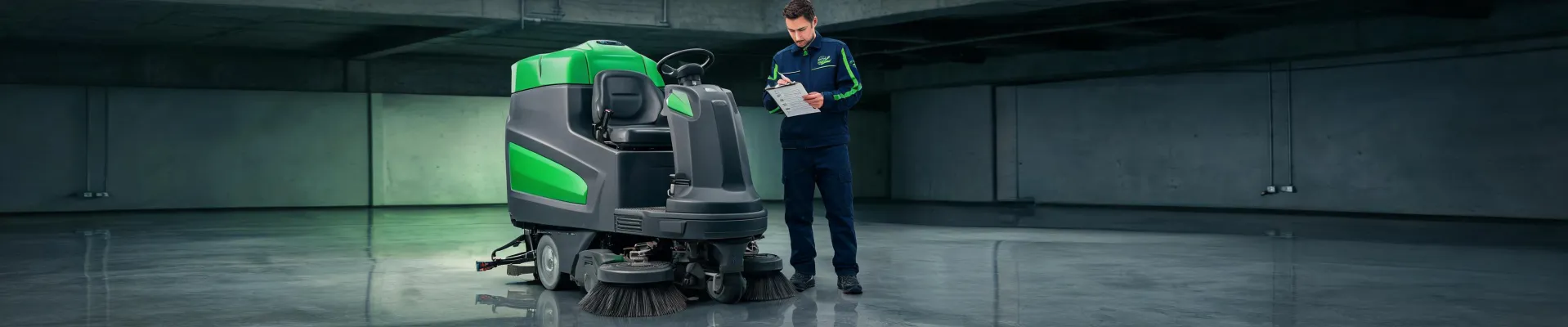
Why Most Floor Scrubber Purchases Fail on Spec, Not Brand: A Quality Manager's View
So here's an opinion that doesn't win me friends at equipment demo days: most floor scrubber purchases go wrong because of the specification, not because of the brand.
That's not me being diplomatic. I'm a quality compliance manager, which means I review equipment specifications before they go out to real facilities — roughly 200 machine specs a year. I've signed off on Tennant scrubbers and sweepers for warehouses, food plants, labs, and retail locations for over six years. And I've also rejected purchases that looked great in the brochure but were plainly wrong for the floor they were supposed to clean.
The uncomfortable truth is that a machine which runs beautifully in one building can be a money pit in another. So I stopped asking "which floor scrubber is the best" some time ago. I started asking a harder question: what is this specific floor asking for?
The 20-inch walk-behind is better than you think — in the right building
The best example is the Tennant 20 inch floor scrubber. It gets dismissed because it's not flashy. It doesn't have an enormous cleaning path or a high-speed travel mode. What it does have is a size that matches how most buildings actually work: standard doorways, tight aisles, and shift changes where you can't wait for a certified ride-on operator to become available.
I saw this play out in a direct comparison back in 2023. We audited two facilities that both covered around 40,000 square feet but had very different layouts. Facility A was one big open warehouse floor with wide aisles and few obstructions. They bought a ride-on scrubber with an aggressive cleaning path. Facility B was split into production rooms and narrow stock aisles. For those contained spaces, they used the walk behind floor scrubber Tennant offers in the 20-inch class, plus a slightly wider unit for the main corridors.
Here's what surprised me: Facility B logged more actual cleaning time per week. Not because the walk-behind was faster — it wasn't. But because it could actually be used. Crews moved it through doorways, maneuvered it around racking, and handed it off between shifts without needing a special operator license. Facility A's machine was more productive in open square footage, but it sat idle for parts of two out of three shifts because only two employees were qualified to run it. The ride-on was efficient on paper and underused on the floor.
Never expected the gap to be that wide. But it taught me a lasting lesson: a machine that's technically capable is worthless if the building and the workforce can't keep it in motion.
For epoxy floors, rental is often the honest answer
Epoxy floors are a different animal. Because they're smooth and sealed, they look simple to maintain. But equipment choice matters more than you'd think. Wrong pad type or a fixed scrub head that applies too much pressure can leave micro-scratches and streaking that show up harshly under warehouse lighting.
It took me about 6 years and maybe 60 epoxy floor inspections to fully understand that. And it changed how I answer the question "should we just buy a machine for our new epoxy floor?" Often, the honest answer is: not yet.
An epoxy floor cleaning machine rental is the move I recommend more often than people expect. Renting for a few weeks lets you test the actual machine on the actual floor with your actual operators — before you make a capital equipment decision. You get real data on pad wear, water usage, and how the finish looks afterward. Around here, rates for that class of machine run roughly $350–$500 per day as of January 2025 (verify current pricing in your market). Compare that with spending $15,000 to $30,000 on a machine based on theory.
I still kick myself over a 2022 project where I didn't push this hard enough. A client with a brand-new epoxy production floor wanted to buy a scrubber immediately. I raised the idea of renting first, but I didn't insist. Six months later, the finish in high-traffic lanes had visibly dulled, and the machine had to be replaced with a model offering adjustable pad pressure. That correction wasn't cheap. Two weekends of rental testing would have exposed the same issue for maybe $1,500 total.
Now let me state the limit of that advice: rental doesn't make sense when you already know exactly what you need and you're cleaning every day. If the floor is epoxy and the soiling is consistent, a properly specced walk-behind scrubber will handle it day in and day out. Rental is for uncertainty — and there's no shame in admitting you have some.
You can't scrub your way out of a sweeping problem
Another spec mistake I keep running into is facilities buying a scrubber to solve what's actually a dry debris problem. Scrubbing and sweeping aren't interchangeable. They're two different passes.
A Tennant Tomahawk floor sweeper is a dry machine. It picks up dust, packaging scraps, metal shavings, and sand dragged in from the yard — all without water. When a facility has continuous dry debris, the Tomahawk is the right first move. Skip that step and send a scrubber straight at the mess, and you'll get clogged filters and a recovery tank full of mud. That's not a brand flaw. That's a process flaw.
And once the space gets truly large — warehouses where aisles stretch further than a few hundred feet — a walk-behind eventually hits an efficiency ceiling. That's when I'll recommend a ride-on such as the SC6500 floor scrubber. The SC6500 is serious equipment: wide cleaning path, high productivity, built for facilities that measure floor area in acres. Its honest limitation is its footprint. It's not designed for tight production rooms or segmented layouts. In the wrong building, an SC6500 becomes an expensive vehicle driving circles around a problem it can't quite reach.
The sequence that works for a lot of operations looks like this: run the Tomahawk over the dry layer, then make a scrubbing pass with the appropriately sized walk-behind, and only scale up to a ride-on like the SC6500 if the open area genuinely justifies it.
"But isn't bigger better?" — that's where budgets go to die
I hear the same pushback whenever I make this argument: "If we're going to buy Tennant anyway, why not get the biggest model we can afford so we don't outgrow it?"
I understand the logic. I just don't agree with it. A machine that's too large for your aisles, or too heavy for your floor's load rating, isn't a long-term asset — it's an expensive mismatch. Undersizing is equally bad. If a 200,000-square-foot warehouse tries to rely on one 20-inch walk-behind, that machine will run constantly and wear out before its time. The real question is whether the unit's size matches the facility layout, operator skill level, floor type, and soil load.
In my Q1 2024 audit, I reviewed 14 equipment failures across the sites we manage. Eleven of them traced back to a spec issue — wrong pad pressure, wrong brush type, or wrong machine class for the space. Only three involved an actual mechanical defect. That single report changed how our team talks about floor care equipment.
So yes, I'm a fan of Tennant machines. Partly because the build quality is consistent, and partly because their lineup covers the range — from a 20-inch walk-behind to the SC6500 — which means there's a better chance of finding the right fit instead of being forced into the wrong one. But I'd say the same thing to any customer with a $10,000 budget: start with the floor, not the logo.
It may not be the most popular view at an industry demo. After six years and roughly 200 specification reviews, though, I'm not chasing the popular view. I'm chasing the one that keeps a machine running, keeps operators safe, and doesn't turn into a procurement post-mortem twelve months later.
Bottom line: buy the specification, not the status. Figure out what your floor is asking for first. The right equipment decision tends to follow.

Elise Marceau
Elise Marceau is an LED display and digital-signage systems analyst covering LED video walls, modular screens, transparent LED, control processors, and indoor or outdoor signage. She applies IEC 62368-1 safety principles while comparing pixel pitch, luminance, contrast, refresh rate, colour uniformity, viewing angle, ingress protection, power density, module serviceability, and signal redundancy. Her specification guides help integrators, venue operators, retailers, and procurement teams align viewing distance, ambient light, content format, installation access, electrical load, and lifecycle support.