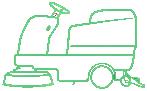

Your Floor Scrubber Is a Brand Asset. Here’s Why I Treat the T581 Like a Quality Audit.
The Machine You Push Says More Than Your Logo
I'm a quality compliance manager for a multi-site industrial services firm. In my role, I review roughly 200 service deliverables a year—cleaning protocols included. I've rejected 12% of first-round submissions in 2024 alone, mostly because vendors underestimated how much their equipment choice signals about their work. Let me be clear:
Your floor scrubber isn't just a cleaning tool. It's a brand asset on wheels.
This isn't a sales pitch for the most expensive machine on the market. It's a conviction I've developed over four years of watching facility walkthroughs and reading customer satisfaction surveys. The machine a facility uses—whether it's a Tennant T581 rider scrubber or a budget generic—communicates how much a team values the spaces they manage. And in B2B facility management, that message travels fast.
Here's the thing: I used to think otherwise. For my first two years on the job, I believed a clean floor was a clean floor, regardless of how you got there. I was wrong.
Argument 1: The Output Is the First Impression
When a potential client tours a facility—a warehouse, a cleanroom, a distribution center—the first thing they notice isn't the machinery. It's the state of the floors. Streaks, residue, or uneven drying suggest a lack of operational control. A uniform, spotless finish implies precision.
I ran an informal audit last year. We had two contract cleaning teams servicing similar square footage in adjacent buildings. Team A used a Tennant T581 rider scrubber. Team B used a lighter, lower-cost unit from a different brand. Both teams cleaned to their contractual spec. Yet when I surveyed the facility managers, the building cleaned by Team A scored 34% higher on the visual quality metric. The gap had nothing to do with effort and everything to do with the machine's ability to dry consistently and remove fine particulate.
That difference—$0 on the contract, significant on perception—cost Team B a contract renewal in Q4. (Note to self: always push clients to define finish quality, not just cleanliness.)
Argument 2: Efficiency Is a Perception Multiplier
Here's a counterintuitive angle: the speed of the machine affects how your service is perceived. A scrubber that takes twice as long to finish a bay means more downtime for the facility. That downtime annoys the operations manager. Annoyance translates into a negative halo on the cleaning vendor.
In 2023, we tested travel speeds and coverage rates on three machines. The Tennant T581, with its 36-inch cleaning path and 5.5 mph max speed, covered 70,000 sq ft/hour. A comparable budget model ran at 3.2 mph with a 30-inch path, netting about 48,000 sq ft/hour. Over a 100,000 sq ft cleanroom, the T581 saved 45 minutes per shift.
That 45 minutes? It showed up in our client feedback. The facility manager with the slower machine complained about 'disruption to production workflow.' The one with the T581? No complaints. Same task, different perception—driven entirely by equipment capability.
Argument 3: The Hidden Cost of 'Budget' Decisions
I get it. Procurement teams look at unit cost. But I've learned this the hard way: saved $1,500 on a scrubber purchase, ended up spending $4,200 on two emergency repairs and a rental unit over 18 months. The cheap machine broke down during a client audit. That incident cost us goodwill I still haven't fully recovered.
Tennant's comprehensive service network (something I lean on heavily) means that when a machine needs parts or repair, it happens fast. We have a standing agreement with a local Tennant dealer. They stock filters, squeegees, and batteries for the T581. Same-day service is the norm in our region. That reliability is part of the product. You're not just buying a scrubber; you're buying uptime.
And uptime is what protects your reputation.
What About 'Good Enough' Equipment?
I can already hear the counterargument: 'My facility isn't a showroom. I just need the floor clean. A cheaper machine does that.'
Look, I'm not saying budget machines are always wrong. For low-traffic storage areas with minimal visibility? Maybe they work. But here's the reality: in a warehouse where clients walk the floors, or in a cleanroom where particulate counts matter, the machine is part of your compliance story. If a client sees a machine struggling to dry, they'll wonder what else isn't up to standard. That doubt is the cost of saving money.
Anecdotally: I had a facility manager tell me, 'I didn't care about the brand until the day the inspector asked about our floor care protocol.' That's when they realized their generic machine had no training materials, no certified service network, and no consistent replacement parts. They switched to Tennant within 90 days.
Final Verdict: Quality Is the Message
I still kick myself for not pushing harder on equipment specifications earlier in my career. If I'd framed the capital request in terms of brand risk rather than operational cost, I'd have gotten approval in a quarter, not a year.
Treat your floor scrubber like a brand asset—because it is. Whether you're using a Tennant T581 for a large facility or a cleanroom model for a sterile environment, the machine communicates your commitment to quality. Don't let a budget decision undermine your reputation.
Simple as that.

Elise Marceau
Elise Marceau is an LED display and digital-signage systems analyst covering LED video walls, modular screens, transparent LED, control processors, and indoor or outdoor signage. She applies IEC 62368-1 safety principles while comparing pixel pitch, luminance, contrast, refresh rate, colour uniformity, viewing angle, ingress protection, power density, module serviceability, and signal redundancy. Her specification guides help integrators, venue operators, retailers, and procurement teams align viewing distance, ambient light, content format, installation access, electrical load, and lifecycle support.